
Creative Courage: Painting with Shadow and Geometry
Celebrating Pakistani immigrant artist Anila Quayyum Agha

A few weeks ago, I went to the Asian American Museum and sat quietly on a wooden bench in front of a lacquered steel cube hanging from the ceiling in a room with brightly colored walls. Light spilled from the center of the cube, using the patterns on the box to paint the walls with light and shadow. Swoops and curlicues suggested leaves and flowers, fences and mandalas. And more.
Entering the room made me part of the exhibit. The art kissed my cheeks and decorated my shoes. My shadow joined the other shadows.
This piece is called A Beautiful Despair.
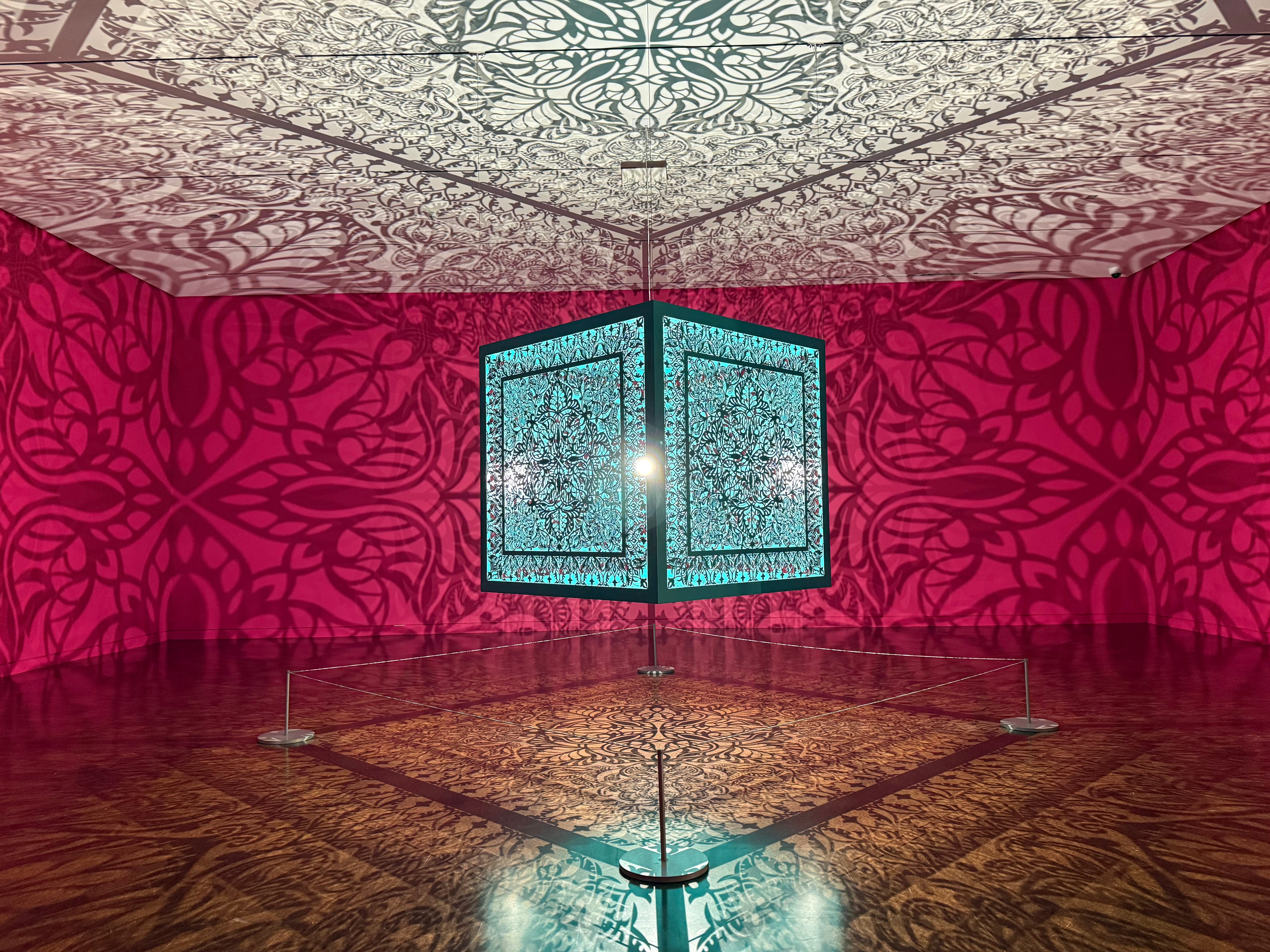
This immersive art is by Pakistani immigrant Anila Quayyum Agha. Her art often addresses the tensions in our world. Beautiful and despair are not often used together. And yet this is the kind of tension that gallops through our world right now. Our garden looked great all summer; almost everything in the public sphere terrified me.
I hope many of us in the Northwest take the time to go to this exhibit. I highly recommend spending time with it. Be in the room. Enjoy it. Feel it. Watch how others react to it. The pictures I had seen of the art were beautiful, but I didn’t feel connected until I was in its physical presence, perhaps not until it painted me with its shadows.
Based on multiple interviews that I listened to with Agha, her work often focuses on the tension between beauty as seen in feminine spaces and in nature, and the cruelty of the world around us. She cares explicitly about the power of the feminine, the importance of inclusivity, and nature. In her own words, in an interview in Aware, she responds to the question “Do you consider yourself a feminist?” partially with these words:
“I think people forget world history and, as an artist educator, I feel it’s my duty to educate not only through my artwork, but also by my feminist art practice to elevate value for women as well as non-binary and LGBTQ people. I guess in a way, I’m an artist for the minorities because I’ve been part of a minority for so long.”
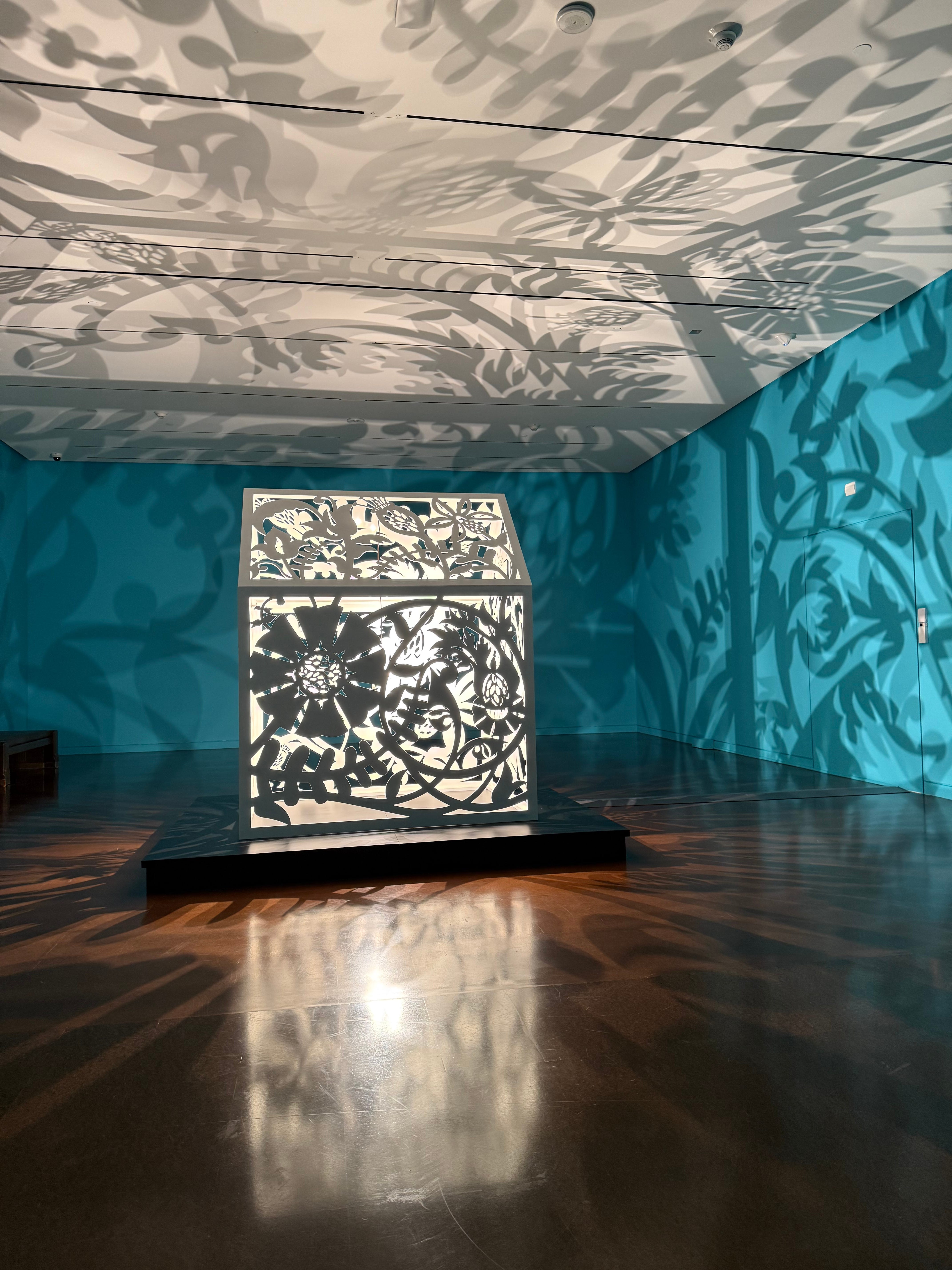
I’ve linked to the entire interview below. I’d like to take a moment to explore her work related to climate change. In addition to A Beautiful Despair, the exhibit includes another sculpture, This is not a Refuge, mounted on a pedestal and also illuminated from within. In an interview with NPR (linked below), Agha says that:
“This is not a Refuge deals with the idea of immigrants. It talks about the divisive narrative we have been provided about how immigrants are the problem. It makes immigrants live in a no-man’s land. The sculpture has no exit or door that allows one to be part of it – immigrant people are living without agency right now…All humans seek home and safety, but this structure looks like home, yet it doesn’t give you safety.”
Later in the Aware piece, the interviewer asks, “In This is Not a Refuge (installation, 2018), you address the issue of migration. Is this a recurring topic in your work?”
“Over the past decade, I have realized that human rights, women’s rights, and environmental politics are intimately connected. The erosion in our environment is immense, with diminishing resources, which in turn fundamentally impacts women worldwide. I think of women on the ground dealing with issues which affect their bodies, their children, their homes, and their income. The personal is political, and my personal politics have over time become the outer skin of my art practice.”
Agha rightly links immigration and refugee status to climate change. I do a lot of writing about climate, but I have always been a resident of the global north. Thus, I can’t possibly understand the current costs of climate as deeply as people who live nearer the equator. Agha grew up in Lahore, Pakistan. India, Pakistan, and Bangladesh are experiencing heat waves earlier and for longer, and in some cases they are so hot that humans cannot survive in the sun for more than a few hours. So Agha comes from a place where the climate kills without storms or floods. This is different from the Pacific Northwest, where the climate impacts we feel are often violent windstorms and drought-fueled infernos. We did experience a heat dome in 2021. That gave us a taste which might be analogous to touching our tongues to a pepper that South Asia has to eat whole. So climate is visceral for people in South Asia in a way that it is generally not (yet) for America or Europe.
The same can be said for most of Agha’s other themes. As an American-born white woman, I can’t possibly understand what it is to be a refugee as deeply as Agha can. I do understand misogyny, as I suspect all women do. But as patriarchal as America is, Pakistan is more so. As much as I often feel excluded, all of us who are white are more included than almost anyone who is not white, at least in America.
Here in Seattle, even though Pakistan is part of Asia, and even though the museum was opened in its current form over thirty years ago, Agha is the first female Pakistani artist to have a showing. She reports that this is a common experience for her. To build her career, she has had to fight misogyny and prejudice. We don’t adequately celebrate female artists, and we do a worse job of appreciating female artists who are not white.
Some of the most important voices are those of immigrants. Their understanding might help us comprehend these times. Agha explores costly mistakes humans are making about how we treat each other and the natural world through art that is quite beautiful. It is as if she is saying yes, there is a danger and damage. But look, we can heal.
Near the end of the NPR interview, the interviewer asks Agha, “What does she hope people take away?”
Agha answers, “Do I have the compassion to understand somebody else’s life? There is such a lack of compassion in our politics right now.”
This is a critical observation, and a good question for all of us in this moment full of othering. Can we understand each other’s lives?
I encourage you to visit the exhibit if you can. While I sat bathed in its shadows and light, I felt as if the work helped me understand both myself and others, while at the same time it bathed me in a nearly spiritual peace.
Useful links:
NPR Interview with Anila on NPR’s Soundside (21 minutes)
Interview with Anila Quayyum Agha: Pattern is Political (Aware)
anila quayyum agha on how life experience led to an impassioned artistic exploration of light (This includes many images of Anila’s work that is not available at the Seattle Asian Art Museum.
2025’s Heat Waves in India, Pakistan, and Bangladesh Gave Arrived (Climate Impacts Tracker Asia)
Most likely up next:
Things I’m reading: I’ve still got Cory Doctorow’s Enshittification: Why Everything Suddenly Got Worse and What to do About It on my reading list, as well as If Anyone Builds It, Everyone Dies: Why Superhuman AI Would Kill Us All by Eliezer Yudkowsky and Nate Soars. In the meantime, I’m reading Nobody’s Girl, by the late Virginia Roberts Guiffre. It’s not an easy read, but very relevant to this moment. Any of these could show up as a post. I’m also looking deeper at poetry as pushback. I hope to get an in-depth piece like this and a reading recommendation out in December.
Personal news for this post:
This post is about a week later than I expected. We had an unfortunate family health emergency that’s resolving, but it put me a bit behind everywhere. There’s mending happening, so all is well. In the meantime, I have two upcoming public appearences:
I am the “Featured Poet” at Duvall Poetry March 3rd, 2026
I will be attending Emerald City ComiCon as a Pro March 5-8, 2026.
If you want to read my recent work, the best place to start is to pick up a copy of When Mother’s Dream: Stories. Here is a recent review at Metamorphosis Reviews. A kind of strange review, but it tickled me that the reviewer listed one of my poems as a favorite (the collection is mostly stories, but there are a few poems in there for spicing).
Thanks for reading!
If you enjoyed this post, please take a moment to share it or like it. I’m not using Substack for a paid subscriber base, but I hope to reach as many people as I can, since I hope this work helps us all speak the hard truths when needed. Agha’s speech is gentle, but that does not make it less important, less true, or less courageous.