
Reading Recommendation - One Day, Everyone will have Always Been Against This, by Omar El Akkad
A brutal mirror, a searing commentary, a book for this moment

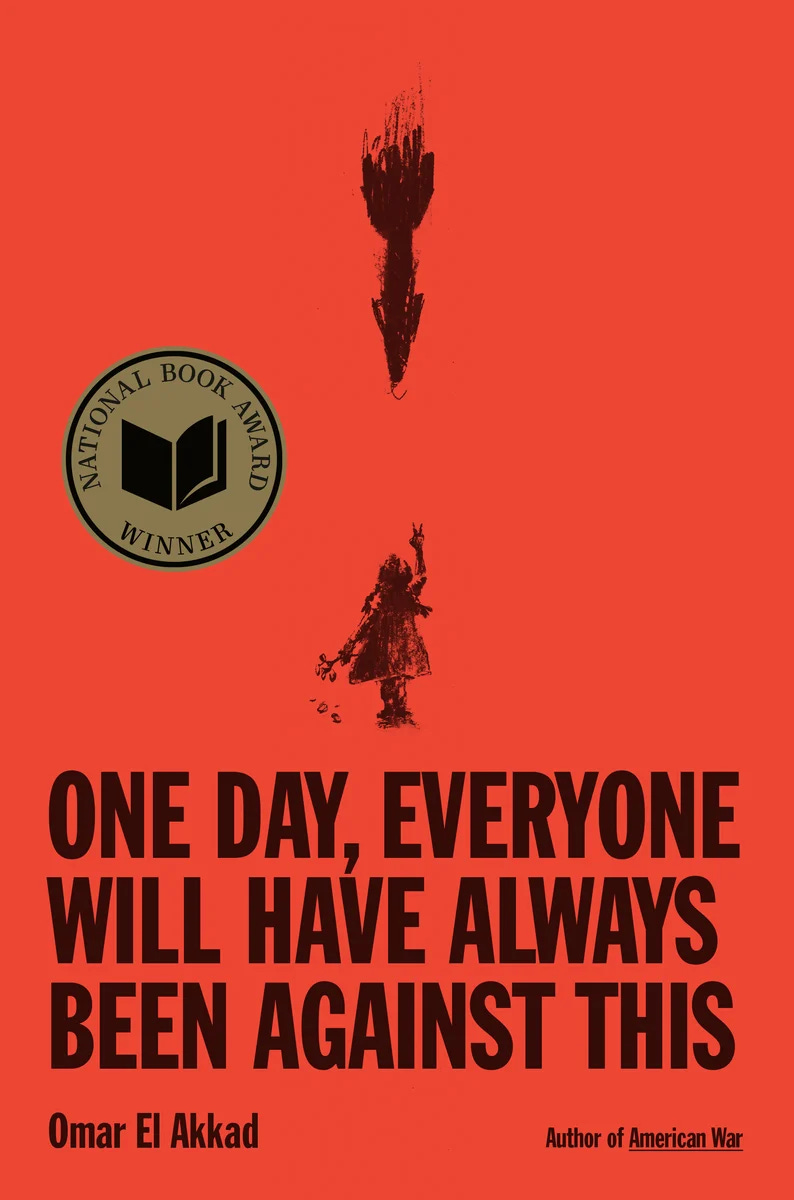
Yesterday, I finished Omar El Akkad’s One Day, Everyone Will Have Always Been Against This. It is one of the best anti-colonialist books I’ve ever read. It’s a gloriously brutal mirror. And then this morning, my country (currently taken captive by extremist, vengeful people) launched a war on Iran. The serendipity and irony of this timing is rich. If you haven’t read Akkad’s book yet, you should. Especially if, like me, you are a fairly comfortable and safe American liberal.
My first brush with Omar El Akkad’s writing happened when I read his novel, American War. It’s excellent. I’m going to re-read it. My second brush was closer. I attended a Seattle Arts and Lecture event where I sat about twenty feet away from the stage as Akkad interviewed Ta-Nehisi Coates. Both were brilliant. So I grabbed this book when I saw it late last year.
One Day, Everyone Will Have Always Been Against This is, lightly, a memoir. But more importantly, the book is evidence that when we wake up in the West and lead our normal lives and maybe attend a casual protest between a breakfast with friends and a trip to the gym, we don’t really understand. We’re not doing enough. Sure, it’s better than being a fascist. But still….
As I sit here watching images from this newly-started war, I am reminded of passages from the book. Akkad lives in Oregon. He talks about the terror of war. He opens chapter two by saying, “In the pauses between onslaught, they arrive at what’s left of the hospitals, missing limbs, skin burned away, maggots crawling out of wounds. The medics are forced to create a new acronym for them. WCNF - Wounded Child, No Surviving Family.”
It’s brutal. He crystallizes terrible images out of the fog of war and into sharp, devastating focus.
But that’s not necessarily the most important part. In a chapter about lesser evils, he says, “It’s difficult to live in this country in this moment and not come to the conclusion that the principal concern of the American Liberal is, at all times, not what one does or believes or supports or opposes, but what one is seen to be.” In a following paragraph, he goes on to say, “The fascists whose ranks exert such outsize influence on Republican politics have come to understand that the veneer of liberalism is a deeply vulnerable thing. Its perfunctory concern with rhetorical evenhandedness gives even the most obviously bad-faith allegation influence…what matters is not the damage done when such nonsense is given oxygen, but the idea of being a person who gives all ideas a fair shake.” This made me profoundly uncomfortable, because it’s an accurate mirror. I protest a few times a month, I write this SubStack, I write subversive stories and poems and publish or sell or read some of them, and then the rest of the time I work out and shop and cook and go through my life in complete physical safety. I try to get along with the republicans in my family and in the public places I frequent. I boycott Target completely and at-best half-ass my boycott of Amazon (it is easy to avoid Target, harder to skip Amazon). There is no reason to assume a bomb will fall on my house tomorrow and kill everyone I love. Oh, I can feel the dangers of nuclear war getting more real, and I could be rounded up for my anti-regime writings, but neither calamity is likely to happen tomorrow. I cannot possibly understand what it is like to live in Gaza, for example.
Last night, at a dinner with people I care about greatly, but who mostly believe differently than me, we briefly risked discussing politics. Almost everyone at the table agreed that any answer must be based on compromise, on meeting in the middle. After reading this book, I bit my tongue. Hard. That’s one of the points Akkad drove home for me – how dangerous it is to look at compromise when the two sides each offer bad options. That’s when it’s time to reject both options. I’m paraphrasing, but Akkad encourages us to see this as equivalent to saying something like, “Politicians might argue that we should kill off all the immigrants or half the immigrants,” when the real question is “Why do we want to kill any immigrants at all?”
Throughout this book, I found myself stopping because well-crafted writing simply forced me to take note of it. Here is one example. As a journalist, Akkad often received information from powerful governments on various topics, which was often heavily redacted. I can think of a lot of heavily redacted files we’ve seen released lately. I’m sure you can, too. He observes that, “Allowed to wield silence so freely, any institution will become insatiable. It’s not only that the absence of information allows those complicit in but unaffected by wrongdoing to look away. The silence itself becomes an empty canvas, onto which any fantasy can be painted. When every last Palestinian journalist has been killed, maybe there will never have been any other Palestinian journalists at all.”
It does feel like we are living in a post-truth world where the high-minded and fine idea of transparent governance has been buried in screeching nonsense. We are being lied to by our own governments. Clearly, we always have been. Forever. But right now no one is even pretending not to lie.
I wanted to quote so many more passages. But I’ll leave you to explore the rest of this book and find Akkad’s moving statements on your own. Allow for a little disorganization – the books jumps around in timeline and topic, but your time spent with it will be rewarded. Especially if you’re willing to look in the mirror.
Perhaps most importantly, as you consume this book and its ideas, consider that its most crucial message, even if it shows most clearly in the title, is that we cannot go on as we have been. There has to be a better way.
Appearances:
March 3: I’ll be the featured reader at Duvall Poetry, which is open to the public.
March 5-8: Emerald City Comic Con. I’ll have a story coming out at the convention. You’ll be able to find me at the Clarion West table and the Grim Oak booth, and maybe a few other places as well.
April 2-5: Norwescon, Seatac, Washington. I’ll be on panels and giving readings from Thursday afternoon through Saturday evening.
Links to my recent work:
When Mothers Dream: Stories is my latest collection of stories and poems. It highlights strong women and climate issues, and you can order a physical or ebook version from the publisher or at most other online outlets.
My story, The Forest Guard Rescue Service, will be released in the Grimoire, a Grim Oak Press Anthology for Emerald City Comic Con 2026.
Sharing/Subscribing:
Please take a moment to comment on this post, share it, or to like it. If you want to subscribe, there are usually two to three similar posts a month. It’s free.
I have been meaning to get that book and it will have to be my next book purchase. Great review, thank you.